From Training to Opportunity: 26 Young Creatives Build Skills for Community Delivery
Newsroom card excerpt
Twenty-six unemployed young creatives received Voices of Ubuntu facilitator development, gaining practical skills, supervised practice and pathways towards paid work in the creative and community-development sectors.
Creative ability does not automatically become a livelihood.
Many young artists, performers and community creatives have talent, lived experience and the ability to connect with an audience. What they may not yet have is access to structured professional development, supervised practice and a clear pathway through which their creativity can become consistent, ethical and paid work.
Voices of Ubuntu brought 26 unemployed young creatives into a facilitator-development process designed to begin building that pathway.
The participants gained practical, work-ready skills and an opportunity to develop towards paid roles within the creative and community-development sectors. As they learnt how to create safe and engaging spaces for others, they were also supported to reflect on their own experiences, reconnect with creativity and grow in confidence.
From creative talent to responsible facilitation
Performing and facilitating are related, but they are not the same.
A performer may know how to hold an audience’s attention. A facilitator must also know how to hold a process.
This means paying attention to:
- who is participating and who remains silent;
- how power operates within the room;
- whether children and young people feel able to contribute;
- when a participant may be becoming overwhelmed;
- how to guide reflection without imposing an answer;
- how to maintain boundaries;
- and how to close a difficult conversation safely.
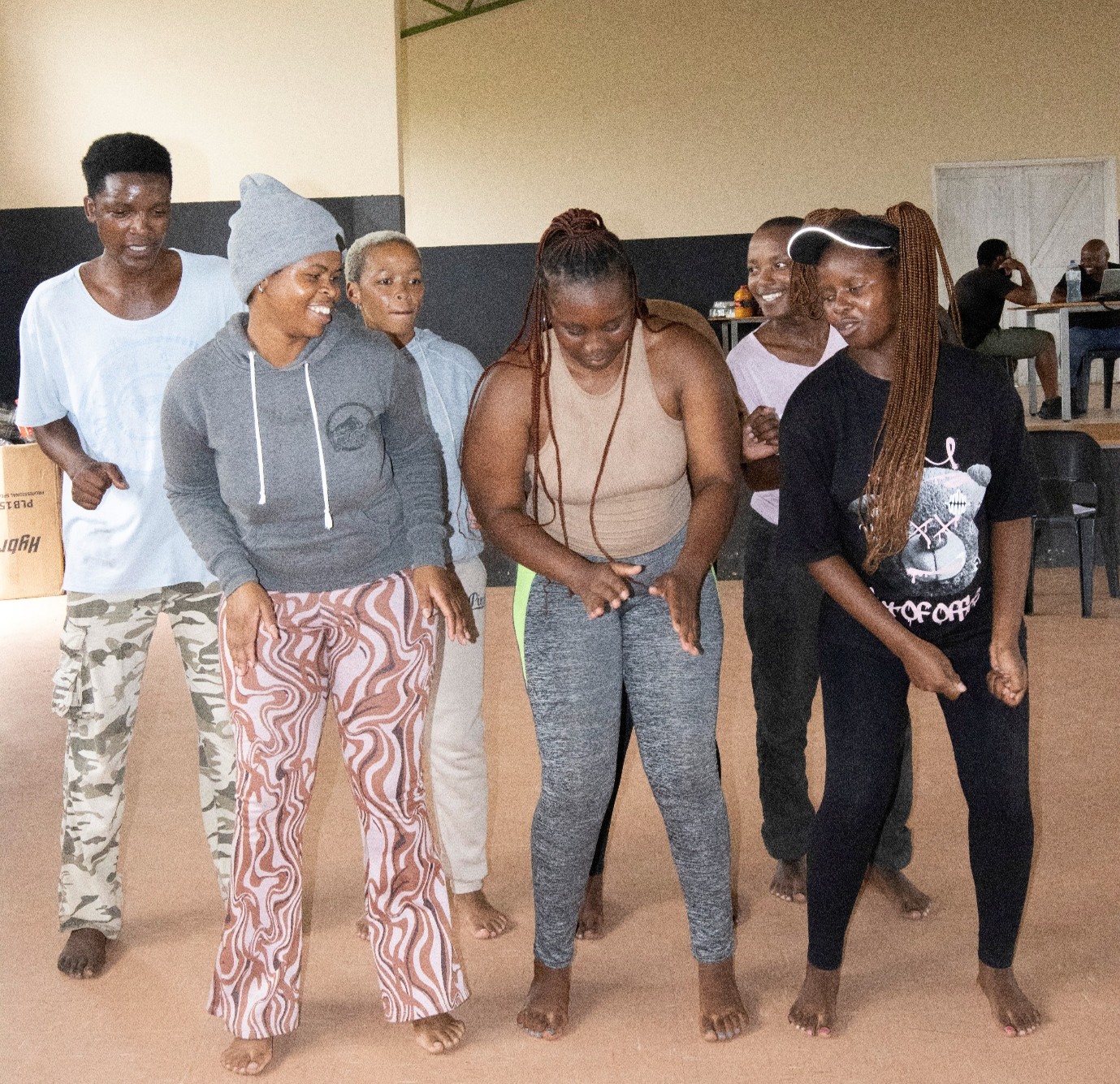
The training therefore moved beyond performance technique. Participants learnt how to establish safe group agreements, notice power and participation, and protect child and youth voice.
They practised emotional literacy, grounding, facilitated dialogue, applied arts and debriefing. They also began connecting the creative method to the less visible disciplines that make responsible programme delivery possible: preparation, documentation, referral, evaluation, safeguarding and professional boundaries.
This is a central principle within Voices of Ubuntu: the arts are not added to a programme simply to make it entertaining. Story, theatre, movement, rhythm and visual expression are used as structured methods through which people can participate, make meaning, understand different perspectives and rehearse new responses.
Learning to create safer spaces
The facilitator’s role is not to arrive with all the answers.
Voices of Ubuntu is rooted in the belief that people and communities already carry knowledge, relationships, cultural memory and the capacity to respond to the issues affecting them.
The facilitator helps make that knowledge visible.
This requires more than confidence on stage. It requires the ability to listen, ask reflective questions, recognise whose voice may be missing and prevent the most powerful people in the room from determining the entire conversation.
Participants were introduced to facilitation that is Ubuntu-rooted, trauma-aware and attentive to group dynamics. They learnt that a safe process depends not only on what activity is delivered, but also on how people are welcomed, how participation is invited, how disclosures are handled and how the session is brought to a regulated close.
The aim is to develop practitioners who can hold dignity and participation together—creating spaces where people can express themselves without being forced to disclose personal experiences.
The person behind the facilitator
Voices of Ubuntu recognises that facilitators do not enter a room as neutral instruments.
They bring their own stories, emotions, assumptions, strengths and unresolved experiences into the work.
The facilitator-development process therefore included opportunities for participants to reflect on their own childhood experiences, reconnect with their inner child and grow in confidence.
This reflective element matters because people who support others also need to understand how they themselves respond to discomfort, silence, conflict, vulnerability and power.
A facilitator who has developed greater awareness of their own reactions is better placed to avoid dominating the process, rescuing participants, becoming overwhelmed or moving into roles that fall outside their responsibility.
The intention is not to produce people who perform expertise. It is to develop practitioners who can remain present, reflective and accountable while supporting others.
Supervised practice turns knowledge into competence
Facilitation cannot be learnt through theory alone.
Participants need opportunities to practise, observe, receive feedback and reflect on what happened. Supervised practice creates a bridge between knowing the principles and being able to apply them when a real group responds in an unexpected way.
Within the Voices of Ubuntu pathway, selected participants may develop towards roles such as:
- programme assistant or co-facilitator;
- Assistant Joker;
- Joker or specialist Forum Theatre facilitator;
- senior facilitator;
- or Ubuntu Mentor.
An Assistant Joker supports the facilitation and safeguarding process while learning through observation and guided practice. A Joker carries the specialist responsibility of facilitating participation during Forum Theatre—helping an audience move from watching a social challenge to examining it, entering the story and testing different responses.
Ubuntu Mentor practice is broader. It equips practitioners to create reflective and participatory spaces across schools, organisations and communities, using Ubuntu-rooted and arts-based methods with appropriate safeguarding, preparation and follow-through.
These are developmental pathways rather than titles gained through attendance alone. Progression depends on practice, demonstrated competence, ethical responsibility and the opportunities available within programme delivery.
Training connected to real work
The broader Voices of Ubuntu model is designed so that programme implementation can create economic opportunity.
When a school, NPO, government department, company, foundation or community partner commissions or funds a programme, the delivery requires real people with different forms of expertise.
Depending on the engagement, paid roles may be created for:
- facilitators and Ubuntu Mentors;
- actors and performers;
- puppeteers;
- writers and storytellers;
- youth creators;
- podcast producers;
- photographers and videographers;
- designers;
- community mobilisers;
- coordinators;
- administrators;
- and programme-support personnel.
Training and supervision can help turn irregular creative opportunities into a clearer pathway of competence, quality and repeat work. In this way, the programme contributes to an arts-based local economy while responding to social and community needs.
The pathway does not separate creative livelihood from social impact.
The creative practitioner earns by helping deliver work that strengthens emotional literacy, youth voice, community dialogue, safeguarding, social cohesion and leadership.
The community receives a professionally delivered programme.
The participant gains practical experience, evidence of delivery and an opportunity to progress.
The organisation builds a stronger pool of people who can carry the work forward.
Paying for the full work behind the programme
Community impact is sometimes built on an expectation that artists, facilitators and local practitioners should give their labour freely because the cause is important.
Voices of Ubuntu takes a different position.
Professional programme costs must include the real work required for quality delivery:
- facilitator and artist time;
- preparation and rehearsal;
- travel and logistics;
- materials;
- safeguarding;
- supervision;
- production;
- documentation;
- evaluation;
- and organisational support.
Making these costs visible protects programme quality and helps prevent the people delivering social impact from remaining unpaid or underpaid.
Voices of Ubuntu quotations are therefore built around the work required—not only around the visible time spent in front of participants.
This is how the social-enterprise and social-impact parts of the model reinforce one another.
Clients commission professional services. Sponsors and funders expand access. Programme income supports delivery capacity and creates opportunities for the artists, facilitators and programme workers carrying the work.
The people delivering the programme are part of the impact the programme creates.
What the training is designed to grow
For the participants, the intended growth extends beyond one workshop or one creative activity.
The facilitator-development pathway is designed to strengthen:
Practical facilitation competence
The ability to prepare, hold and close a structured participatory process.
Ethical and safeguarded practice
Understanding consent, confidentiality, role boundaries, child and youth participation, disclosure response and referral.
Reflective leadership
The ability to notice one’s own responses, receive feedback and lead without controlling every outcome.
Group-process skills
Listening, questioning, balancing participation, recognising power and responding constructively to group dynamics.
Work readiness
Preparation, punctuality, teamwork, professional conduct, documentation and responsibility for agreed deliverables.
Employability and progression
A foundation for supervised programme delivery, repeat work, further learning and selected facilitator, Joker or Ubuntu Mentor pathways.
Community delivery capacity
A growing pool of people who understand local language, culture and realities and can help deliver structured programmes close to where people live and learn.
The programme profile summarises these intended areas of growth as local facilitation competence, ethical practice, peer support, employability, institutional capacity and a stronger pool of community-embedded process workers.
Two forms of value from one investment
The 26-person facilitator-development cohort demonstrates the dual purpose at the heart of Voices of Ubuntu.
The first form of value lies in the people being trained. They gain practical capability, reflective experience and a clearer pathway towards paid creative and community-development work.
The second lies in the communities and institutions they may go on to serve. Every well-prepared facilitator strengthens the pool of adults able to create safer spaces, protect participation and use the arts as a disciplined tool for dialogue and development.
This is not only about training young people to deliver a programme.
It is about building local capability.
It is about recognising creative work as real work.
And it is about creating an ecosystem in which professional delivery, social impact and dignified livelihoods can grow together.
Strong delivery earns trust. Trust creates repeat work. Repeat work sustains people, quality and community access.